
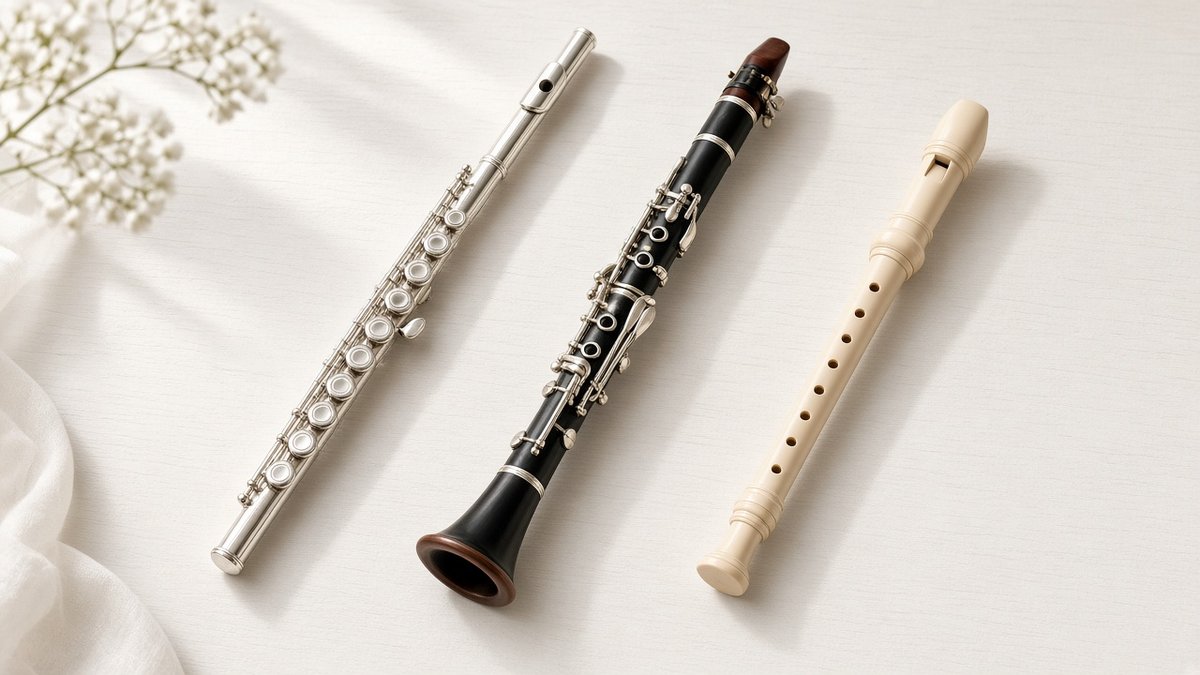
Finding a woodwind instrument for small hands matters more than most parents realise. A child who cannot cover the tone holes on a clarinet or reach the low keys on a flute will produce squeaks and missing notes no matter how hard they practise, and most of them conclude they are simply bad at music. The instrument is at fault, and there are straightforward solutions. Here is what works.
Woodwind Options for Small Hands Compared
| Instrument | Reach Demands | Adaptation Available | Suitable From |
|---|---|---|---|
| Flute with curved head | Low | Curved headjoint shortens reach | Age 7 to 8 |
| Clarinet | Moderate to high | Key extensions, plateau models | Age 9 |
| Alto saxophone | Moderate, plus weight | Harness, adjustable thumb rest | Age 10 |
| Recorder | Very low | Sopranino and soprano sizes | Age 5 |
Flute with a Curved Headjoint: The Best Small Hands Option
The easiest woodwind instrument for small hands is a flute with a curved headjoint. It folds the instrument back on itself, which brings the keys several centimetres closer to the body and removes the stretch that makes a straight flute impossible for a young child. Many student flutes are sold with both headjoints, so the instrument grows with the player.
- Curved head removes the reach problem entirely
- Light instrument with no weight on the neck
- Swap to the straight head as the child grows
- Slightly less clear tone than a straight headjoint
- Kits with both heads cost more
Clarinet: Good With the Right Adjustments
As a woodwind instrument for small hands, the clarinet’s problem is not reach so much as coverage, because the finger holes must be sealed by the pads of the fingers with no gaps. Small fingers struggle, which produces squeaks and dead notes. Key extensions solve part of it, and the Yamaha YCL-255 has a key layout that suits smaller hands better than most.
- Comfortable key placement for young players
- Light resin body with no neck strap needed
- Key extensions and thumb rest cushions available cheaply
- Open tone holes still demand full finger coverage
- Very young children may need to wait a year
Alto Saxophone: Weight Before Reach
The saxophone has no open tone holes, so coverage is not the issue. Weight is. At around 2.5 kg hanging from a neck strap, an alto is hard work for a small player, and the answer is a properly padded strap or a harness rather than a different instrument.
- Closed keys mean no finger coverage problems
- Quick early progress keeps children motivated
- Adjustable thumb rest on most student models
- Heaviest option here by a wide margin
- Needs a good strap or harness from day one
How to Test Before Buying
Have the child hold the instrument in playing position for two minutes. If their wrists bend sharply, if their shoulders rise, or if they cannot reach a key without shifting their grip, the fit is wrong. Squeaks on clarinet are usually a coverage problem rather than an embouchure problem, and the test is simple: ask them to cover the holes and press, then look for gaps.
Remember that a woodwind instrument for small hands is a temporary category. Children grow quickly, and a curved headjoint or a padded strap is a bridge rather than a permanent decision. See our guides to the best clarinets for kids, the best flutes for kids and the best saxophone straps for kids.
Frequently Asked Questions
What age can a child start a woodwind instrument?
Recorder from around five, flute with a curved head from seven or eight, clarinet from nine and alto saxophone from about ten, depending on size.
Do key extensions actually help?
Yes. They are inexpensive, a technician fits them in minutes, and they solve reach problems on specific clarinet keys without altering the instrument permanently.
Is the recorder a waste of time?
Not at all. It teaches breath control, finger coordination and reading, and it transfers directly to flute and clarinet later.
Charlotte Moore

Charlotte Moore is a Clarinetist by profession and has over time offered lessons on how to play the clarinet among other musical instruments. And while a majority of clarinet players are well versed with the process of settling with a good clarinet among other accompanying features. There is little information about clarinets. The reason why Charlotte prepared comprehensive experts touching on the various facets of the clarinet. The consolidated information will offer more insight on everything clarinets including the best stand to use, and the best plastic clarinet that you can invest in, among other information. Charlotte Moore is a devoted mother of two and a professional clarinet player.