
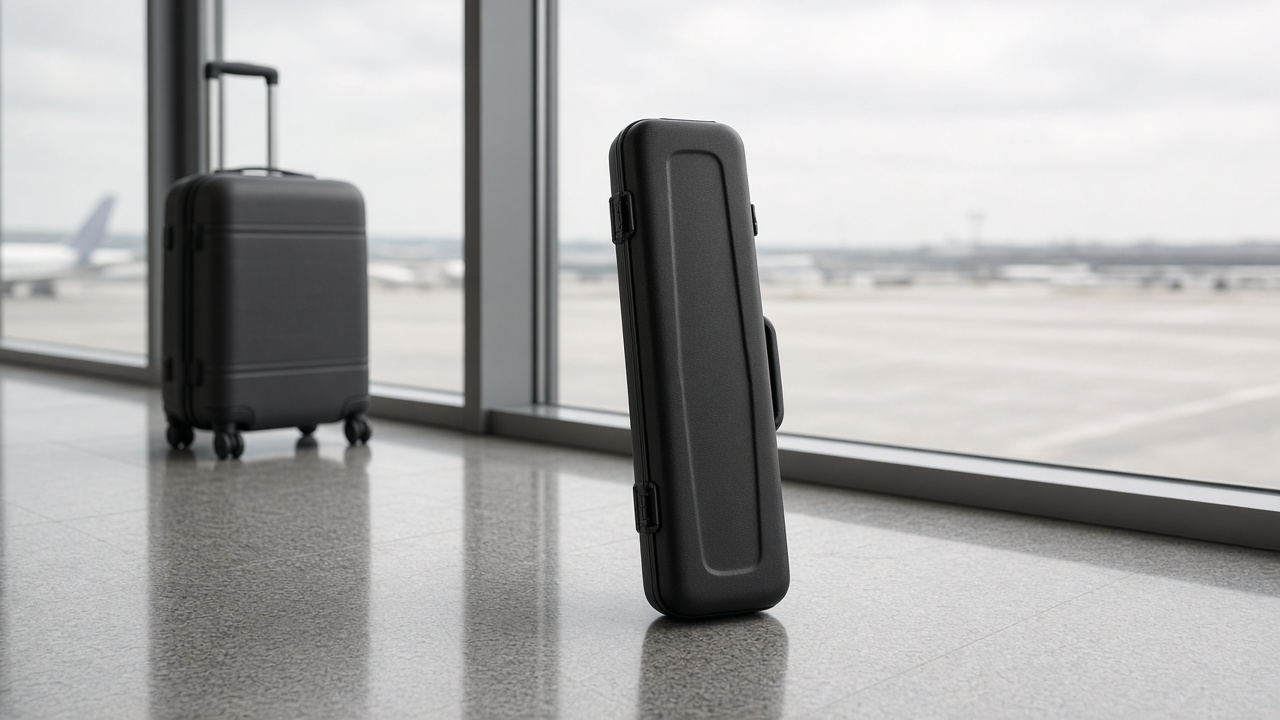
The safest way to fly with a clarinet is to carry it on. A checked hold is where cases get crushed, delayed, or left in cold, dry air for hours. US Department of Transportation rules give you a clear starting point for cabin carriage, but they do not reserve a bin for you. The case still has to fit, and there still has to be space when you board.
This is not another general case roundup. For everyday school and concert cases, see Best Clarinet Cases: What Actually Protects Your Instrument. The question here is narrower: which compact cases have official dimensions that make cabin stowage realistic, and how should you pack the instrument for a flight.
Air Travel Cases Compared
| Case | Official size and weight | Shell | Official price |
|---|---|---|---|
| BAM Hightech Bb (3027XL) | 12.4 x 8.9 x 3.9 in; 1 lb 13 oz | Triple-ply coated, insulated ABS Hightech shell | $531.00 on Bam Cases |
| Protec Slimline PRO PAC (PB307) | 13.5 x 5 x 9.5 in | Shock-absorbing frame, 1680 ballistic nylon | $115.00 on Protec (stated as MSRP) |
Both official external measurements are compact compared with a bulky student outfit case. Airline carry-on limits still vary, so check the airline you are actually flying before you travel. A slim case helps. It does not override a full overhead bin.
What the US Rule Actually Says
Under 14 CFR 251.3, a covered US carrier must let a passenger carry a violin, guitar, or other small musical instrument in the cabin without a fee beyond any standard fee that carrier charges for comparable carry-on baggage, if two conditions are met. The instrument must be stowed safely in a suitable cabin compartment or under a seat, in line with FAA carry-on rules. And there must be space for that stowage at the time the passenger boards.
That second condition is the one players miss. The rule is not a guaranteed bin at the end of the boarding line. Board early enough to use available space, keep the clarinet as your cabin bag when the airline treats it that way, and have a plan if the flight is completely full. Do not assume a late-boarding clarinet will be waved into a seat-back pocket.
BAM Hightech 3027XL: The Rigid Cabin Case
Bam Cases lists the Hightech Bb clarinet case, reference 3027XL, at $531.00. Official external measurements are 12.4 inches long, 8.9 inches wide, and 3.9 inches deep, with a stated weight of 1 pound 13 ounces. Official materials describe contoured shells made with Bam’s Hightech technique: a triple-ply coated and insulated ABS structure, a slimline design with no exterior handles, and a high-density foam cradle. Bam also notes that the interior is molded on and fitted best for a Buffet Crampon RC clarinet, while still being made for Bb clarinet.
That RC-fit note matters. If you play a Yamaha or another pattern, confirm that your joints, barrel, and bell sit properly in the cradle before you trust this case on a trip. The official size and rigid shell are the reason it belongs in an air-travel conversation: it is compact, light, and much more crush resistant than a floppy gig bag.
Pros
- Official exterior size of 12.4 x 8.9 x 3.9 inches, compact enough for many cabin bins
- Light official weight of 1 pound 13 ounces
- Rigid, insulated Hightech shell, better suited to bumps than a soft bag
Cons
- Official price of $531 is a serious accessory purchase
- Bam says it is fitted best for a Buffet RC, so other brands should be test-fitted
- A rigid case still needs bin space at boarding
Protec Slimline PB307: The Lighter Everyday Travel Case
Protec’s official Slimline PRO PAC case for Bb clarinet, SKU PB307, is listed at $115.00 on the official site, which Protec says are manufacturer’s suggested retail prices. Official exterior dimensions are 13.5 inches long, 5 inches wide, and 9.5 inches high, with a large exterior pocket. Official features include a lightweight shock-absorbing frame and 1680 ballistic nylon with zig-zag stitching.
This is the more practical case for a player who wants something slim for school, rehearsals, and occasional flights, without spending several hundred dollars. It is not as rigid as the BAM Hightech shell. For cabin use, the official 13.5 by 9.5 inch footprint is still compact, but the 9.5 inch height is the number to compare with your airline’s published carry-on limit.
Pros
- Official MSRP of $115, far below a Hightech cabin case
- Slim official footprint, with a useful exterior pocket
- Shock-absorbing frame and ballistic nylon for daily carry as well as flights
Cons
- Less rigid than a hard Hightech shell if the bag is crushed
- At 9.5 inches high, it is taller than the BAM case and may be tighter against some limits
- Not a substitute for boarding early and carrying the instrument on
How to Pack a Clarinet for a Flight
Swab the instrument thoroughly before you pack, then close it in the travel case. If it is a wooden clarinet, include your usual case humidifier, not a dripping tube. A two-way pack such as a Boveda Size 8 is easier to fly with than a freshly soaked Dampit. For humidity details, see Wood Clarinet Care and Preservation. Keep reeds in a proper reed case, not loose in a pocket. Our clarinet reed case guide covers that side of the kit.
Do not check the clarinet unless you have no other option. If a gate agent forces the issue, ask again about cabin stowage, photograph the case, and know your insurance. A hard shell is the less bad choice in the hold, but the hold is still the hold.
Frequently Asked Questions
Can I carry a clarinet on a US flight?
A covered carrier must allow a small musical instrument in the cabin without an extra fee beyond a standard carry-on fee if it can be stowed safely and if there is space when you board, under 14 CFR 251.3. Check your airline’s size rules and board early enough to use that space.
Should I ever check a clarinet?
Only if cabin stowage is genuinely impossible. The hold adds crush risk, delay risk, and humidity and temperature swings. A rigid case is safer than a gig bag in that situation, but carrying on is the better plan.
Will the stock student case work?
Some student outfit cases are bulky and awkward in a bin. Measure the case you already have against the airline’s published carry-on limit. If it is oversized, a compact travel case such as the BAM Hightech or the Protec Slimline is the point of this guide.
Charlotte Moore

Charlotte Moore is a Clarinetist by profession and has over time offered lessons on how to play the clarinet among other musical instruments. And while a majority of clarinet players are well versed with the process of settling with a good clarinet among other accompanying features. There is little information about clarinets. The reason why Charlotte prepared comprehensive experts touching on the various facets of the clarinet. The consolidated information will offer more insight on everything clarinets including the best stand to use, and the best plastic clarinet that you can invest in, among other information. Charlotte Moore is a devoted mother of two and a professional clarinet player.