
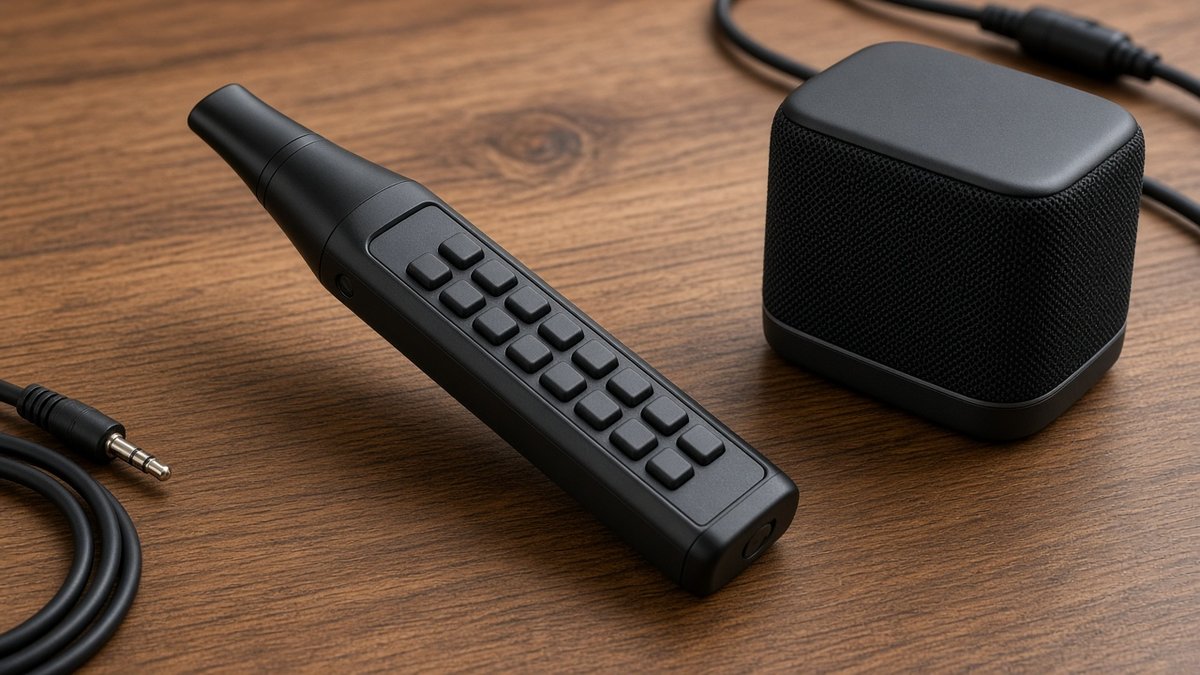
The Akai EWI Solo is the cheapest serious electronic wind instrument on the market, at around $385, and it comes from the company that invented the category. It has 200 sounds, a built in speaker, a rechargeable battery and a seven octave range. It also has a fingering system that is not quite like any acoustic instrument, which is the single biggest thing to understand before buying one. Here is what it does well and who it suits.
Akai EWI Solo Specifications
| Feature | Detail |
|---|---|
| Sounds | 200 onboard voices |
| Range | Seven octaves |
| Keys | Touch contacts, no moving parts |
| Fingering modes | EWI, sax, flute, oboe, and more |
| Power | Rechargeable internal battery |
| Connectivity | USB MIDI, headphone out, built in speaker |
What Makes the Akai EWI Solo Different
There are no moving keys. Your fingers rest on metal contacts that respond to touch, which means note changes happen the instant a finger lifts. Players who have spent time with it can play passages faster than any acoustic woodwind allows, and there is no key noise at all.
The trade is that it feels nothing like a saxophone. Acoustic players usually need two or three weeks before the instrument stops fighting them, and some never adjust. Selectable fingering modes help, including sax, flute and oboe layouts, but the physical sensation remains different.
Breath and bite sensors handle expression. The bite sensor gives vibrato and pitch bend, and the breath sensor is responsive enough for musical phrasing, though it is less nuanced than Yamaha’s or Roland’s.
- Cheapest capable electronic wind instrument by a wide margin
- Seven octave range, far beyond any acoustic woodwind
- Rechargeable battery rather than disposable cells
- Built in speaker for practice without headphones
- Extremely fast key response with no mechanical noise
- Touch contacts feel alien to acoustic players at first
- Breath response less nuanced than Yamaha or Roland
- Plastic build feels less solid than the price rivals
- Onboard sounds are usable rather than outstanding
As a MIDI Controller
This is where the EWI earns its keep. Plugged into a laptop over USB, it turns any software instrument into something you play with breath rather than fingers, and wind parts written on a keyboard never sound as natural as ones played this way. For producers and composers, it is a cheap route into expressive wind programming.
The onboard voices are perfectly usable for practice and small gigs, but most owners end up driving external sounds within a few months.
Who Should Buy It
Buy the Akai EWI Solo if you want to experiment with breath controlled synthesis without spending four figures, if you are a producer looking for expressive wind parts, or if speed and range matter more to you than acoustic realism.
Choose something else if the goal is silent practice that maintains saxophone technique, because the Yamaha YDS-150 does that far better with a real mouthpiece and reed. Our best electronic wind instruments roundup and the Roland Aerophone vs Yamaha YDS comparison cover those options.
Frequently Asked Questions
Is the Akai EWI Solo hard to learn?
The touch contacts take a few weeks to feel natural for acoustic players. Sax fingering mode shortens the adjustment considerably.
Can it be played silently?
Yes. Plug in headphones and the only sound in the room is your breath, with no key noise at all.
Does it work with a DAW?
Yes, over USB MIDI. It is one of the most affordable ways to control software instruments with breath.
Charlotte Moore

Charlotte Moore is a Clarinetist by profession and has over time offered lessons on how to play the clarinet among other musical instruments. And while a majority of clarinet players are well versed with the process of settling with a good clarinet among other accompanying features. There is little information about clarinets. The reason why Charlotte prepared comprehensive experts touching on the various facets of the clarinet. The consolidated information will offer more insight on everything clarinets including the best stand to use, and the best plastic clarinet that you can invest in, among other information. Charlotte Moore is a devoted mother of two and a professional clarinet player.