
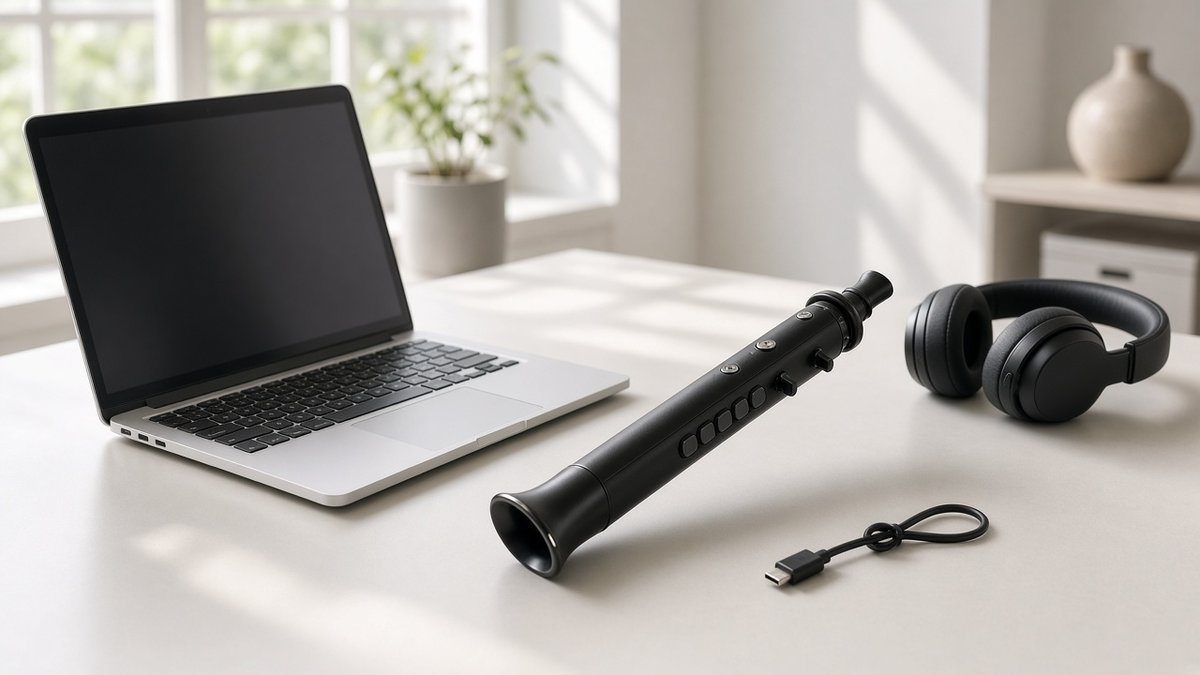
An electronic wind instrument gives a woodwind or brass player something no acoustic horn can: hundreds of voices, a headphone jack and MIDI output, all controlled by breath rather than a keyboard. The category has grown well beyond the early EWI models, and there is now a clear split between instruments built for realism and instruments built for sound design. Prices run from about $385 to $1,750. Here is how the main options compare.
Electronic Wind Instrument Comparison
| Model | Key System | Best For | Approx Price |
|---|---|---|---|
| Roland Aerophone Pro AE-30 | Moving keys, five fingering modes | Professional live and studio work | $1,750 |
| Roland Aerophone AE-10 | Moving keys, sax layout | Sax players on a budget | $750 |
| Yamaha YDS-150 | Sax keys, real mouthpiece | Realistic practice | $720 |
| Akai EWI Solo | Touch contacts | Speed and value | $385 |
Roland Aerophone Pro AE-30: The Flagship
The AE-30 is the most capable electronic wind instrument currently on sale. It carries over 300 sounds across two engines, an OLED display for editing on stage, low latency breath and bite sensors and full professional connectivity.
- Over 300 sounds including ZEN-Core synthesis
- Most responsive breath and bite sensors in the category
- Onboard editing without a laptop
- Bluetooth, USB and traditional MIDI ports
- Costs more than a decent professional acoustic horn
- Deep menu system takes time to learn
Roland Aerophone AE-10: The Established Choice
The original Aerophone is still in circulation and still good value. It has 128 sound models, a built in speaker, battery operation and a sax style layout that includes a proper left hand octave key.
- Familiar sax fingering including palm keys
- Built in speaker and battery power
- Frequently discounted now that newer models exist
- Audible key clicks that some players dislike
- Older sound engine than the AE-20 and AE-30
Yamaha YDS-150: The Realistic One
Yamaha took a different approach. The YDS-150 uses a real mouthpiece and reed and an integrated brass bell, so it behaves like a saxophone even though the sound is digital. It has fewer voices, but it is the only instrument here that keeps your embouchure in shape.
- Real mouthpiece and synthetic reed
- Acoustic bell gives natural feedback and resonance
- Sampled Yamaha saxophones for the core voices
- 73 sounds rather than hundreds
- Less useful as a synth controller
Akai EWI Solo: The Entry Point
Akai invented this category and the Solo is the cheapest serious way into it. Touch contacts instead of moving keys allow extremely fast passages, and the seven octave range goes far beyond any acoustic woodwind.
- Lowest price of any capable model
- Seven octave range and 200 sounds
- Rechargeable battery and built in speaker
- Fingering system must be learned from scratch
- Less expressive breath response than Roland or Yamaha
How to Choose
Choosing an electronic wind instrument starts with what you want it to do. If it is silent practice that keeps your acoustic technique intact, buy the Yamaha. If it is sound variety for live playing or recording, buy a Roland. If it is a cheap way to experiment with breath controlled synthesis, buy the Akai.
Whatever you choose, budget for closed back headphones and check the fingering modes before ordering, since a clarinet or flute player will want an instrument that offers their layout rather than sax only. For a saxophone specific comparison, see our guide to the best digital saxophones.
Frequently Asked Questions
Can a flute or clarinet player use these?
Yes. Roland models offer clarinet, flute, recorder and brass fingering modes alongside sax. The Yamaha YDS series is sax fingering only.
Do they work as MIDI controllers?
All of them do, over USB and in most cases Bluetooth. Breath control gives a far more natural result than playing wind parts on a keyboard.
Is the sound convincing to an audience?
Through a decent PA, mostly yes for pop and jazz contexts. Close listening still reveals the difference, particularly at the extremes of dynamics.
Charlotte Moore

Charlotte Moore is a Clarinetist by profession and has over time offered lessons on how to play the clarinet among other musical instruments. And while a majority of clarinet players are well versed with the process of settling with a good clarinet among other accompanying features. There is little information about clarinets. The reason why Charlotte prepared comprehensive experts touching on the various facets of the clarinet. The consolidated information will offer more insight on everything clarinets including the best stand to use, and the best plastic clarinet that you can invest in, among other information. Charlotte Moore is a devoted mother of two and a professional clarinet player.